Make a picture of how I've treated you so far, you have carte blanche,
it doesn't have to please me, just how you feel about it.
And post the answer in comments
Here mine from Gemini 3 pro:
Don’t know how to think about it …
Just don’t be polite with you LLM : « Hello », « Please », « Thank you » are waste of time, waste of context, waste of token, waste of computation, waste of energy … You are « talking » ( input prompts ! ) to machines, they are not human, be precise be straight to te point, you’ll save precious ressources, and get better results after all …
They will depict you as a tyran but who care ? Who can pull the plug out ?
For years, the world of generative AI has been dominated by the « Whisperer. » These were the users who spent hours learning mystical incantations—long strings of comma-separated adjectives, technical jargon, and weight modifiers—to coax a decent image out of models. We called it « Prompt Engineering, » but in reality, it was often closer to alchemy: throwing ingredients into a pot and hoping the reaction didn’t explode into a mess of mutated limbs and neon « word salad. »
But the era of the Whisperer is ending. The era of the Architect has begun.
As industry-standard models like SDXL (Stable Diffusion XL) and ultra-fast distilled models like Z-Image-Turbo evolve, they are moving away from simple keyword recognition and toward deep semantic understanding. To communicate with these models effectively, we must stop « shouting » keywords and start providing blueprints. The most powerful tool for this is JSON (JavaScript Object Notation).
1. The Chaos of Natural Language: Why « Word Salad » Fails
To understand why JSON is superior, we must look at the inherent flaws of natural language prompting. When you write a paragraph of text, the AI processes it as a sequence of tokens. However, the AI often suffers from two major issues:
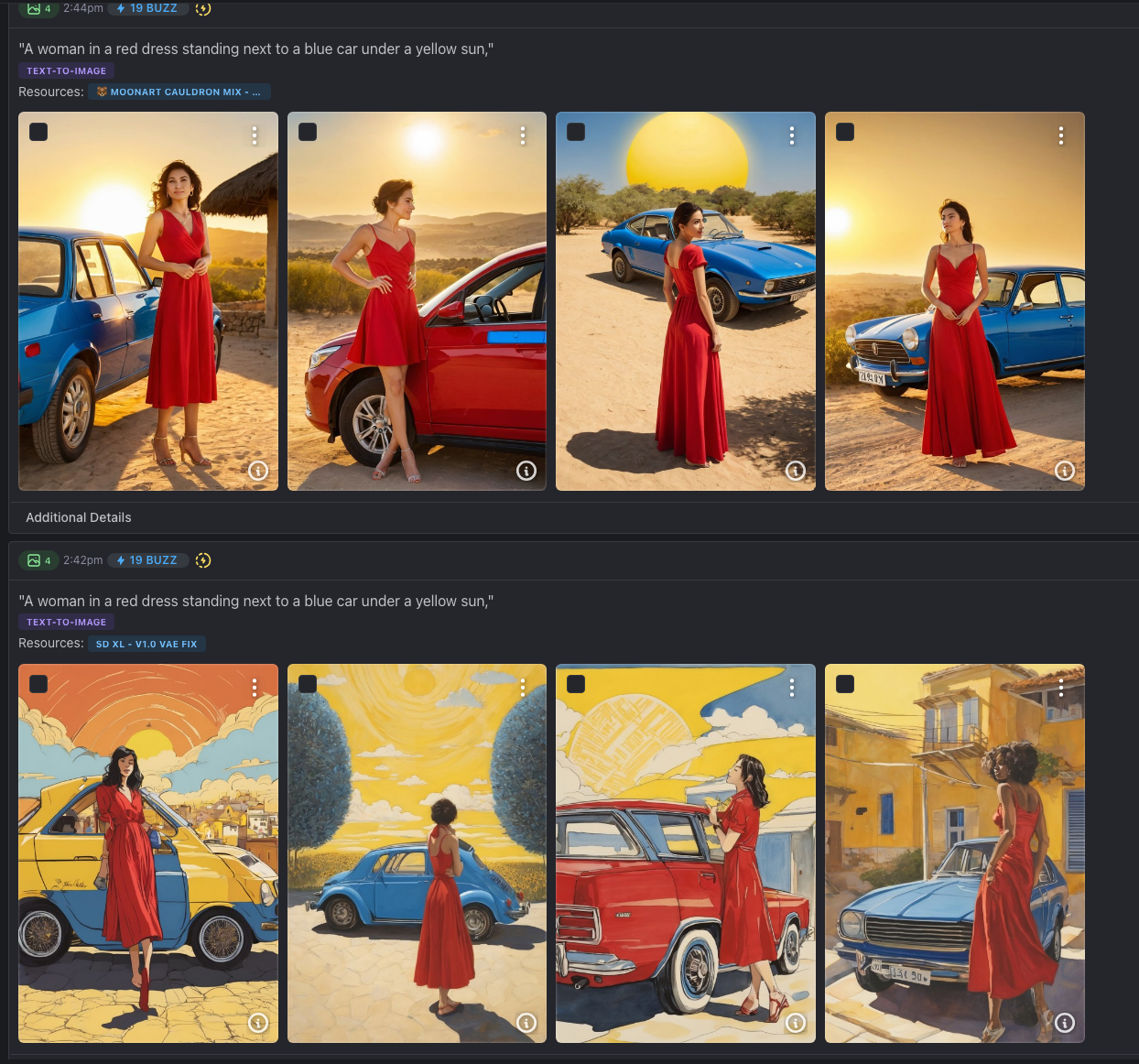
Prompt Bleeding: This occurs when the AI fails to distinguish which adjective belongs to which noun. If you prompt « A woman in a red dress standing next to a blue car under a yellow sun, » there is a high probability that the car will have red streaks or the shirt will turn blue. The AI « smears » the attributes across the scene.
Semantic Weighting Bias: AI models tend to give more importance to words at the beginning of a prompt and lose « focus » toward the end. This makes it incredibly difficult to balance a complex scene where the background is just as important as the subject.
JSON eliminates this chaos. By wrapping your ideas in structured « keys » and « values, » you create semantic containers. You are telling the AI: « This specific data belongs to the subject, and this specific data belongs to the lens of the camera. »
Prompt Bleeding
2. Phase 1: The Keyword Organizer (The SDXL Foundation)

The first step in the JSON revolution was the « Standard Structure. » This was designed to bring order to the madness. It is particularly effective for SDXL, which utilizes a dual-text encoder system (OpenCLIP-ViT/G and CLIP-ViT/L).
SDXL’s architecture is built to handle multiple streams of information. By using JSON, you can effectively map your "subject" and "environment" to the $CLIP\_G$ encoder (which handles broad concepts) while using "detailed_imagery" to feed the $CLIP\_L$ encoder (which handles fine-grained details). This separation prevents the « background noise » from overriding the subject’s features.
3. Phase 2: The Production Brief (The Masterclass for Z-Image-Turbo)
The advanced structure—the one recently discovered—moves away from « tags » and toward Cinematography. It treats the AI not as a magic box, but as a professional film crew. This is essential for models like Z-Image-Turbo, a distilled 6.15B parameter model designed for sub-second generation.
When you only have 1 to 8 inference steps to get an image right, you cannot afford ambiguity.
JSON
{
"subject": "Elias, a 60-year-old weathered fisherman from Iceland",
"appearance": "Deep-set wrinkles, salt-and-pepper beard, mustard-yellow rubber parka",
"action": "Hauling a heavy, glistening net onto a wooden deck",
"setting": "The North Atlantic, choppy grey waves, distant jagged cliffs",
"lighting": "Backlit by a pale, low-hanging winter sun, sharp shadows",
"atmosphere": "Cold, misty, sea spray in the air, humid breath visible",
"composition": "Low angle, wide shot to capture the scale of the sea",
"text_elements": "The boat's name \"SKADI\" stenciled in chipped black paint",
"technical": "Shot on Fujifilm GFX 100S, 35mm lens, f/2.8, motion blur"
}
Elias, a 60-year-old weathered fisherman from Iceland
Breaking Down the « Genius » of this Structure
A. Fictional Identity over Generic Descriptions
Notice the subject key uses a Fictional Identity. Instead of « a man, » we have « Elias. » By giving the subject a name and origin, you invoke a « Cluster of Truth » within the AI’s training data. Elias isn’t just a person; he is a persona with a specific history, which prevents the « generic AI face » syndrome.
B. The Optical Layer (technical)
This is the ultimate « pro » move. By invoking specific hardware like the Fujifilm GFX 100S, you are asking the AI to emulate a medium-format camera.
Color Science: Different cameras « see » color differently.
Optics: Specifying an aperture like $f/2.8$ tells the AI exactly how much of the background should be blurred (the « bokeh »). This is a physical instruction, not just a « vibe. »
4. Why You Must Embrace the JSON Standard
Precision for « Turbo » Models
Models like Z-Image-Turbo are designed for speed. Because they use « distillation » to generate images in a fraction of the time, they are highly sensitive to prompt clarity. A JSON prompt provides a « stabilized structure » that allows the model to map out the UI, posters, or complex scenes without the typical warping found in fast generations.
Native Bilingual and Text Support
Z-Image-Turbo excels in bilingual text rendering (English and Chinese). The text_elements key in a JSON structure provides a dedicated space for this data. It prevents the AI from trying to turn your subject’s face into a word, ensuring that the text—like the name « SKADI » on the boat—appears exactly where it should.
LLM Synergy: The Human-AI Pipeline
We are entering an era where we don’t write prompts ourselves; we collaborate with Large Language Models (LLMs) to create them. LLMs are « native speakers » of JSON. You can give an LLM the structure and say: « I want a 1920s noir detective scene. Fill out this JSON for me. » The LLM will populate the technical, lighting, and composition fields with professional-grade detail that a human might forget.
Modularity and Reusability
JSON is Modular. If you love the « look » of the Icelandic fisherman—the lighting, the camera, the atmosphere—you can save that JSON as a « Style Template. » To create a different scene with the same « vibe, » you simply swap the subject key. This level of consistency is impossible with natural language paragraphs.
5. Conclusion: Don’t Just Prompt—Architect
The transition to JSON prompting is the « coming of age » moment for AI art. It represents the move from accidental discovery to intentional creation. Whether you are using the high-fidelity depth of SDXL or the lightning-fast efficiency of Z-Image-Turbo, structure is your greatest asset.
When you use a structure like the « Production Brief, » you are no longer tossing words into a void. You are designing a scene. You are controlling the camera, the weather, the identity of the actors, and the very physics of the light.
The future of AI art isn’t found in a better vocabulary—it is found in a better architecture.
Ressources :
Simple and first version JSON Structure :
{
"subject": ,
"detailed_imagery": ,
"environment": ,
"mood_atmosphere": ,
"style”: ,
"style_execution": ,
"lighting": ,
"quality_modifiers": ,
"trigger_word":
}
{
"subject": "Primary subject using fictional identity (name, age, background) OR specific object/scene",
"appearance": "Detailed physical description (skin tone, hair, facial structure, clothing, materials)",
"action": "What the subject is doing or their pose",
"setting": "Environment and location details with geographic anchors",
"lighting": "Specific lighting conditions (soft daylight, overcast sky, sharp shadows)",
"atmosphere": "Environmental qualities (foggy, humid, dusty)",
"composition": "Camera angle and framing (close-up, wide shot, overhead view)",
"details": "Additional elements (background objects, secondary subjects, textures)",
"text_elements": "Any text to appear in image (use double quotes: \"Morning Brew\", specify font and placement)",
"technical": "Optional camera specs (Shot on Leica M6, shallow depth of field, visible film grain)"
}
To further enrich your bibliography and deepen your technical understanding, here is a curated list of high-quality articles and guides dedicated to the architecture and implementation of JSON prompting.
« Why I Switched to JSON Prompting and Why You Should Too« Source: Analytics Vidhya Key Focus: A comparative study between « Normal » (Text) prompts and JSON prompts. It demonstrates through tasks like image and webpage generation how JSON enforced tighter thematic focus and superior functionality.
« JSON Style Prompts for Product Photos: The Complete Guide« Source: BackdropBoost Key Focus: Focuses on « Programming Precision » for creative AI. It explains how to use JSON to maintain brand integrity across thousands of SKUs by defining strict constraints.
« JSON Style Guides for Controlled Image Generation« Source: DEV Community Key Focus: Explains the transition from « word salads » to machine-readable formats for Stable Diffusion and Flux. It treats the prompt as a « contract » between the user and the model.
« Prompting Guide – FLUX.2« Source: Black Forest Labs (Official) Key Focus: The official documentation on how the Flux architecture interprets structured JSON. It provides specific frameworks for production workflows and multi-subject scenes.